




Patek Philippe 5270P-014 — Chronograph Perpetual Calendar in Platinum
Jan
Patek Philippe 5270P-014 Perpetual Calendar Chronograph — Salmon Dial Platinum Mastery
Grand Complication Review • 8 Sections • Updated 2026
What Makes the 5270P-014 Special
The Patek Philippe 5270 family launched in 2011 as the successor to the legendary 5970, which itself replaced the iconic 3970. That lineage matters. Each generation refined the integration of perpetual calendar and chronograph complications, and the 5270 represented Patek’s first fully in-house movement for this complication type.
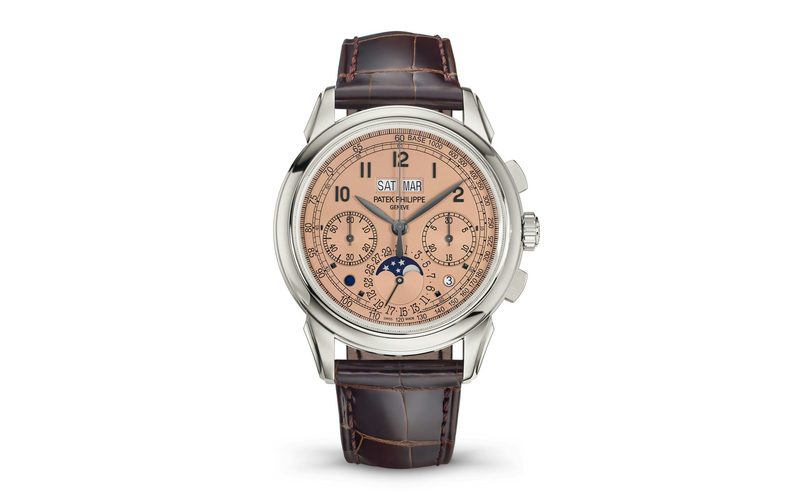
The P-014 variant, introduced in the platinum 950 case with a salmon (sometimes called “rose gold” or “saumon”) dial, pushed the 5270 into territory that stopped collectors mid-sentence. Salmon dials have always been rare at Patek. The 5070P had one. The 5270P-001 wore one briefly. But the 014 dial executes the color with a warmth and depth that photographs consistently fail to capture. In natural light, the dial shifts between copper, peach, and antique rose depending on the angle — a behavior you only witness when the watch is physically on your wrist.
The 41.3mm platinum case weighs noticeably more than gold equivalents. Pick up a 5270R in rose gold and then pick up the 5270P — the density difference is immediate. Platinum sits at 21.45 g/cm3 versus gold’s 19.3 g/cm3. That 11% density increase translates to a wrist presence that gold simply cannot match. It is not just heavier. It sits differently. It anchors itself.
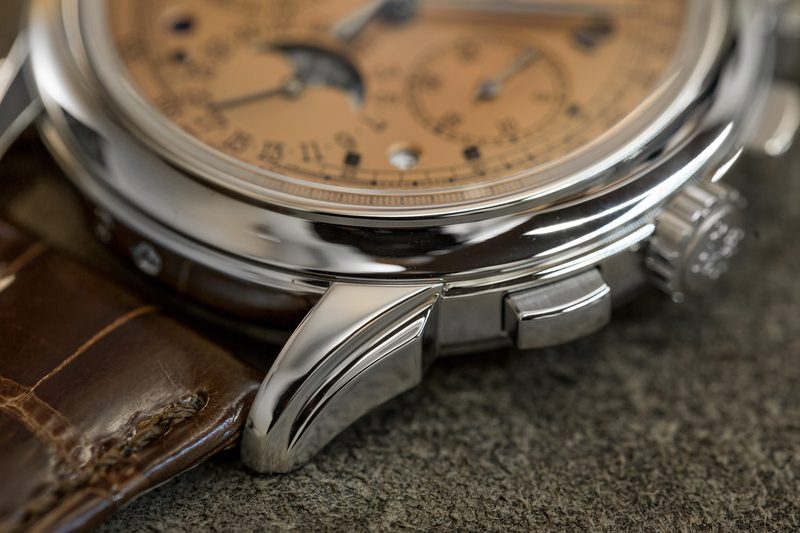
Expert Note: Platinum cases are challenging to finish because the metal resists polishing. Where gold yields smoothly under the polishing wheel, platinum fights back. Achieving mirror surfaces on platinum requires specialized techniques and more time. This is one reason platinum cases command premiums — the labor hours are genuinely higher.
The Salmon Dial — Why Color Matters in High Horology
Salmon dials occupy a peculiar position in watchmaking. They are not universally loved the way a black or white dial might be. They polarize. And that polarization is precisely what makes them valuable — both aesthetically and commercially. A collector who owns a salmon-dial Patek has made a deliberate choice. It signals confidence, knowledge of historical references, and an unwillingness to follow the obvious path.
Tip: The 5270P perpetual calendar tracks date, day, month and leap year automatically. The moonphase should only drift one day every 122 years.
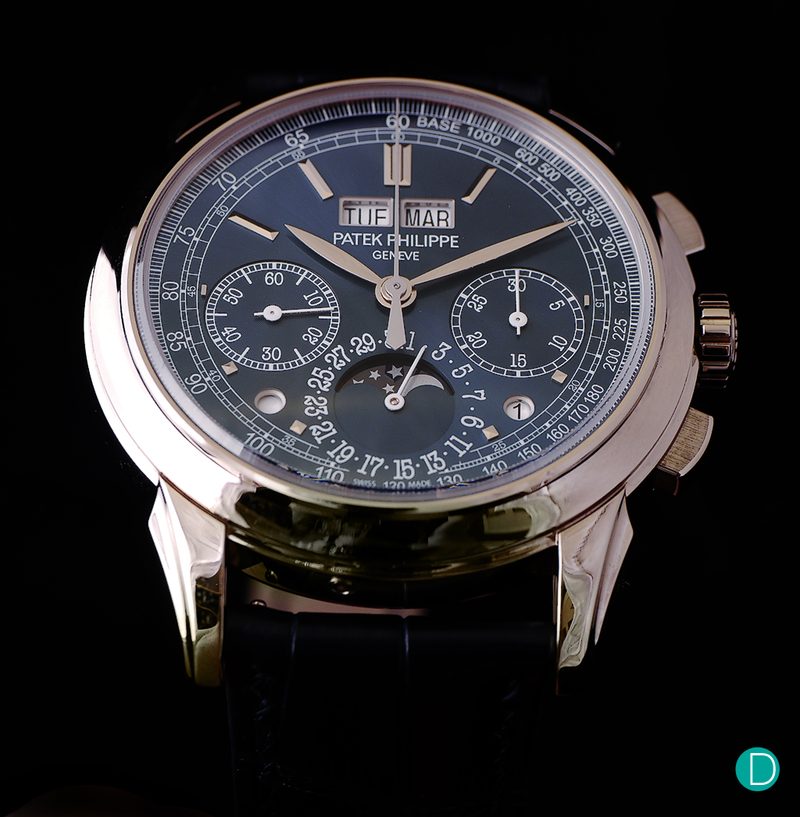
The 5270P-014 dial is not a flat salmon. It carries a sunburst finish underneath the color, which means the salmon tone radiates outward from the center in concentric light patterns. The applied hour markers are white gold with a polished finish — they catch light against the warm dial background and create contrast that a printed index could never achieve. Leaf-shaped hands in white gold complete the picture.
Three sub-dials manage the perpetual calendar information: day at 9 o’clock, date at 3 o’clock, month and leap year at 12 o’clock. The moon phase aperture sits at 6 o’clock — and the 5270P-014 uses the familiar Patek pointed-star night sky against a deep blue background. The chronograph’s 30-minute counter shares the 12 o’clock sub-dial with the month display, an integration that requires careful reading but reduces dial clutter.
Caliber CH 29-535 PS Q — The Movement Inside
The CH 29-535 PS Q is Patek Philippe’s in-house chronograph perpetual calendar movement. Let me break that reference number down because every letter tells a story. CH = chronograph. 29 = caliber family. 535 = specific variant. PS = perpetual calendar with seconds. Q = quantieme (French for “date,” indicating the perpetual calendar module).
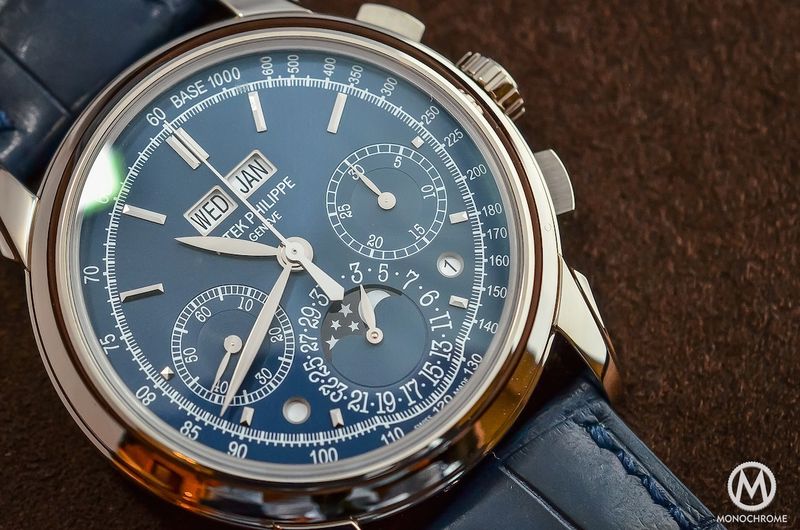
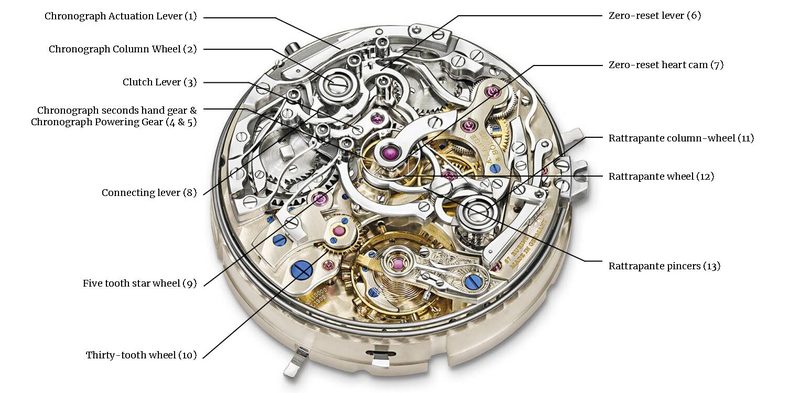
This movement carries 456 individual components. The chronograph section uses a column wheel and horizontal clutch — Patek’s preferred architecture since they abandoned the Lemania-based movements used in older references like the 3970 and 5970. The column wheel provides clean start/stop/reset action. The horizontal clutch eliminates the jerk you sometimes feel on vertical-clutch chronographs when engaging the seconds hand.
The flyback function deserves attention. On a standard chronograph, resetting during timing requires three actions: stop, reset, restart. A flyback chronograph compresses that to one: press the reset pusher while the chronograph runs, and the seconds hand snaps to zero and immediately begins counting again. For timing consecutive events — lap times, for instance — the flyback function saves critical seconds.
The perpetual calendar side tracks day, date, month, leap year cycle, and moon phase. The moon phase complication in the CH 29-535 PS Q deviates from the actual lunar cycle by only one day every 122 years. That level of precision in a mechanical calculation — no electronics, no GPS correction — still impresses me after three decades of handling these watches.
Tip: If a perpetual calendar ever stops running, do NOT use the correctors to advance through months blindly. The instantaneous perpetual calendar mechanism can be damaged if correctors are pressed during the transition window (roughly 10 PM to 2 AM). Wind the watch, let it run, and set it during daytime hours. If the calendar is months behind, a watchmaker should handle the correction.
Flyback Chronograph + Perpetual Calendar — Why This Combination Is Rare
Combining a flyback chronograph with a perpetual calendar in a single movement is among the most challenging tasks in mechanical watchmaking. Each complication alone demands dozens of additional components. Stacking them requires that the chronograph mechanism and the calendar mechanism coexist without interfering with each other — mechanically or visually on the dial.
Insight: Patek chose platinum for the 5270P-014 because its density gives the chronograph pushers a more satisfying tactile response compared to lighter gold versions.
The chronograph requires consistent torque delivery from the mainspring to maintain amplitude during timing. The perpetual calendar requires periodic bursts of energy to drive the instantaneous date change. At midnight, when the perpetual calendar snaps all its displays forward, the power draw increases momentarily. If the chronograph is running at that exact moment, the movement must deliver enough energy to both systems simultaneously without affecting the chronograph’s accuracy. Patek engineered the CH 29-535 PS Q to handle this exact scenario.
Fewer than five manufacturers currently produce an in-house flyback chronograph perpetual calendar. Patek Philippe, A. Lange & Sohne, and Vacheron Constantin come to mind. Several others use modular construction — bolting a perpetual calendar module onto a base chronograph caliber. Patek’s approach is fully integrated, meaning the complications were designed together from the ground up.
The 5270 Lineage — From 3970 to Present
Understanding the 5270P requires knowing where it came from. The perpetual calendar chronograph at Patek Philippe follows a direct line of succession that spans half a century.

The 2499, produced from 1951 to 1985, is the grandfather. Only 349 examples were made across four series. The 3970, introduced in 1986, brought the perpetual calendar chronograph into a smaller case (36mm) and used the Lemania 2310-based CH 27-70 Q movement. The 5970, which ran from 2004 to 2011, enlarged the case to 40mm and used the same Lemania-based movement — refined, but not in-house.
The 5270 broke that Lemania dependency. Launched in 2011, it was the first Patek perpetual calendar chronograph with a fully in-house movement. The CH 29-535 PS Q represented years of development and signaled Patek’s commitment to mechanical independence. Every 5270 variant since — rose gold, yellow gold, white gold, and the platinum P-014 — uses this same caliber family.
The Succession
2499 (1951-1985) → 3970 (1986-2004) → 5970 (2004-2011) → 5270 (2011-present). Each reference increased the case size, and the 5270 finally brought movement production entirely inside the Patek Philippe manufacture in Plan-les-Ouates.
Wearing the 5270P — Real-World Experience
At 41.3mm, the 5270P sits in the modern sweet spot for dress complications. Not too large for formal wear, not too small to read the calendar sub-dials comfortably. The thickness at 12.67mm is honest for a movement with 456 parts — thinner would compromise reliability or require exotic (read: fragile) construction.

The alligator strap with platinum fold-over clasp contributes to the overall weight. On the wrist, the 5270P feels planted. It does not slide around. It does not rotate. The case sits where you place it and stays there. That stability comes from weight distribution — platinum is dense, and the case is thick enough to keep the center of gravity low on the wrist.
Reading the dial takes practice. Three sub-dials plus a moon phase plus chronograph hands plus the main time display — there is a lot of information in 41.3mm of dial space. After a week of daily wear, your eyes learn to scan specific zones: time at the center, date at 3, day at 9, month at 12, moon at 6. The salmon color actually helps legibility because the warm background provides strong contrast against the white gold markers.
The pushers have a firm, precise action. The chronograph start/stop at 4 o’clock requires deliberate pressure — you will not accidentally trigger it. The flyback reset at 2 o’clock snaps the seconds hand back to zero with a satisfying mechanical immediacy. The correctors recessed into the case band require a stylus or pusher tool to operate, which prevents accidental calendar changes.
Insight: The diamond indicator at 6 o’clock on the bezel is a Patek Philippe signature for platinum cases. It serves no functional purpose — it is a discreet material identification mark that tells other watch enthusiasts the case is platinum without needing to flip the watch over. A small detail, but one that platinum owners appreciate.
The 5270P-014 Replica — What Enthusiasts Should Know
A Patek Philippe 5270P replica captures the case design, dial layout, and overall proportions of the genuine reference. The salmon dial color is achievable through modern dial manufacturing — and the best examples nail the warm copper-peach tone convincingly. The applied markers, leaf hands, and sub-dial configuration follow the original design closely.
The perpetual calendar complication in a replica operates differently from the genuine. Most replicas use a modified Asian movement that displays day, date, and month — but these are typically annual or simple calendar configurations rather than true perpetual calendars. The visual result appears correct on most days of the year. The mechanical difference becomes apparent at the end of February and during month transitions of varying length.
The chronograph function works as a genuine chronograph in quality replicas. The flyback feature — where the seconds hand resets and restarts in a single pusher action — is present in the best versions. The column wheel is typically replaced with a cam-lever system, which affects the feel of the pushers slightly but not the function.
Case finishing represents where Patek Philippe replicas have improved most dramatically in recent years. The alternating polished and brushed surfaces on the 5270P case are now executed with genuine attention to transition lines. The Patek Philippe clone movement options available today offer reliability that matches or exceeds many mid-tier Swiss watches, with accuracy typically within 10-15 seconds per day.
For collectors drawn to the 5270P aesthetic — the salmon dial, the platinum weight, the perpetual calendar layout — a well-made replica delivers daily wearability and visual satisfaction. Pair that with the knowledge from our best Patek Philippe replica guide, and you can make an informed choice that fits your collecting goals.
Frequently Asked Questions
What does “flyback” mean on the 5270P chronograph?
Flyback allows you to reset and restart the chronograph in a single pusher press, without stopping first. On a standard chronograph you must stop, reset, then restart — three actions. Flyback reduces this to one. It was originally developed for pilots timing consecutive flight legs.
How often does the perpetual calendar need correction?
A genuine 5270P perpetual calendar accounts for months of different lengths and leap years automatically. The only correction needed is in the year 2100 — which is a century year not divisible by 400, making it an exception to the leap year rule. The moon phase requires correction once every 122 years.
Why is the salmon dial so sought after by collectors?
Patek Philippe has used salmon dials sparingly throughout its history, making them inherently rare. The color carries warmth that photographs struggle to capture accurately — it shifts between copper, peach, and rose depending on lighting. That visual depth, combined with scarcity, drives collector demand.
What is the diamond at 6 o’clock on the bezel?
The small diamond set into the bezel at the 6 o’clock position is Patek Philippe’s traditional indicator for platinum cases. It serves as a discreet material identification — visible to those who know what to look for, invisible to everyone else.
Can a 5270P replica accurately replicate the perpetual calendar?
The visual layout of the perpetual calendar is accurately reproduced in quality replicas — day, date, month, and moon phase displays are all present and functional. The mechanism typically operates as an annual or simple calendar rather than a true perpetual, meaning occasional manual correction at month transitions is needed.
The Patek Philippe 5270P-014 represents a pinnacle of traditional watchmaking — two supreme complications united in a platinum case with a dial color that stops conversation. Whether you encounter it at auction, through an authorized dealer’s years-long waitlist, or through a well-crafted replica, the design language speaks the same message. Mechanical mastery, expressed through restraint. That is the Patek way. And the salmon dial? It is how Patek whispers while everyone else shouts.