


Patek Philippe Nautilus Tiffany Edition — The 170-Piece Legend
Jan
Patek Philippe Nautilus Tiffany Blue 5711/1A-018 — The Watch That Broke Every Rule
Limited Edition • 170 Pieces • 2021 Collaboration
Quick Navigation
The Patek Philippe Nautilus Tiffany Blue is not just a watch. It is a cultural event compressed into 40 millimeters of stainless steel. To understand why this piece commands eight figures at auction and why grown adults cried when they missed the allocation list, you need to know the full story — from Tiffany’s 170-year relationship with Patek Philippe to the mechanics of the dial lacquering process that gives Ref. 5711/1A-018 that specific, stomach-punch shade of turquoise blue.
The Backstory Nobody Expected
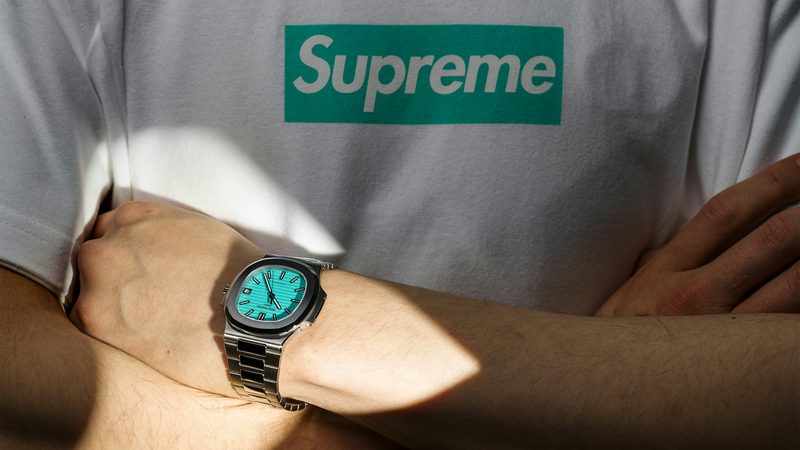
Patek Philippe and Tiffany & Co. have done business since 1851. That is not a typo. Antoine Norbert de Patek met Charles Lewis Tiffany at the Great Exhibition in London and began supplying watches to the American jeweler almost immediately. For over a century and a half, Tiffany-signed Patek Philippe watches have existed — but always quietly. You might see a “Tiffany & Co.” stamp on a Calatrava dial at a Christie’s auction every few years. Collectors knew about them. Nobody else cared.
That changed in 2021. LVMH had just acquired Tiffany for $15.8 billion in January. By December, Patek Philippe announced the end of the Nautilus 5711 — the single most desired stainless steel sports watch on Earth, a piece with waiting lists measured in decades — and simultaneously dropped a collaboration nobody saw coming.
The story goes that Thierry Stern, Patek’s president, agreed to 170 pieces as a farewell gesture to the 5711 reference and a nod to the brands’ partnership. 170 — matching the years of collaboration. Every single piece was allocated before anyone outside the inner circle knew they existed.
Historical note: Tiffany-stamped Patek Philippe dials have appeared since the 1850s. An 1889 Tiffany-signed Patek pocket watch sold at Sotheby’s for $1.1 million in 2019. But the 5711/1A-018 turned a niche collector interest into front-page news.
Anatomy of the Tiffany Blue Dial
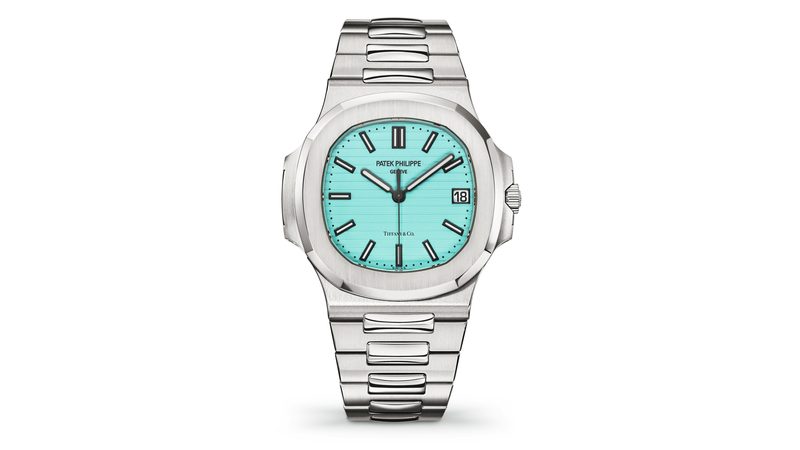
The color. That is what everyone talks about. Pantone 1837, Tiffany’s proprietary shade — trademarked, guarded, unmistakable. When applied to the Nautilus dial with its characteristic horizontal embossing, the result is disorienting in person. Photographs cannot capture it accurately. The lacquer shifts between blue and green depending on the angle, the lighting, the season. Under fluorescent store lighting it reads turquoise. Under a warm incandescent desk lamp it leans green. In direct sunlight it practically glows.
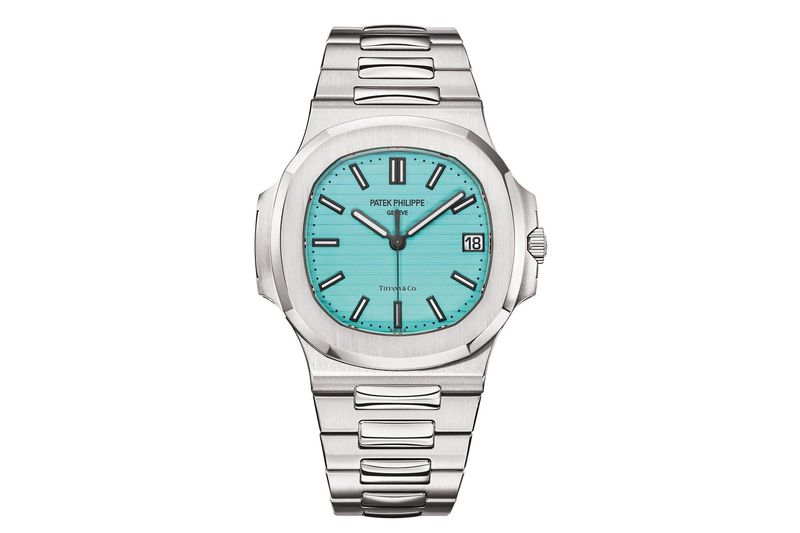
Patek’s dial workshop in Plan-les-Ouates applied the color using their standard multi-layer lacquering process — but the shade itself came from Tiffany. Each dial received approximately twelve coats of lacquer, dried between applications, then hand-stamped with the horizontal embossing pattern that gives the Nautilus its visual texture. At six o’clock, below the Patek Philippe Geneve text, sits the “Tiffany & Co.” signature in matching white print.
Dial Details at a Glance
Color: Pantone 1837 (Tiffany Blue)
Texture: Horizontal embossing
Indices: Applied white gold batons
Hands: Dauphine, white gold
Date: Window at 3 o’clock
Signature: “Tiffany & Co.” at 6 o’clock
Mechanically, the 5711/1A-018 is identical to the standard blue-dial 5711/1A-010 that preceded it. Same Caliber 26-330 S C automatic movement, same 45-hour power reserve, same 120-meter water resistance. Patek changed nothing under the hood. They did not need to. The 5711 was already mechanically flawless after years of incremental refinement. The entire point was the dial — and it delivered.
The $6.5 Million Hammer — Phillips New York, December 2021
Phillips auctioned one of the 170 pieces on December 11, 2021, at their New York salesroom. The estimate was listed as “upon request” — the auction house’s polite way of saying “we have no idea where this is going.” The opening bid started at $1 million. Within ninety seconds it passed $3 million. At $5 million the room went quiet — then a phone bidder pushed it to $6,503,000 including buyer’s premium.
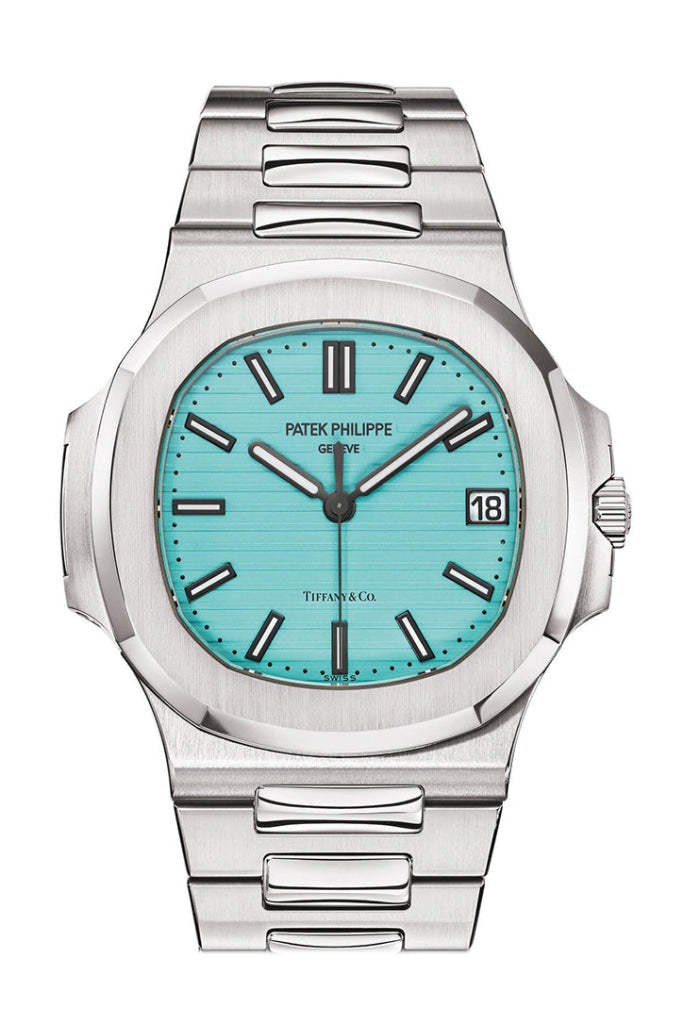
All proceeds went to The Nature Conservancy, a condition Patek Philippe had set for this specific lot. The buyer remains anonymous. The underbidder remains anonymous. But the price — $6.5 million for a stainless steel time-and-date watch with no complications — broke records that still stand.
To put that $6.5 million figure in perspective: the Tiffany Blue sold for roughly 40 times the secondary market value of a standard 5711 at the time. It outperformed most Patek Philippe grand complications at auction — watches with minute repeaters, tourbillons, and perpetual calendars. A time-and-date watch. Stainless steel. No gemstones. Just that dial color and a Tiffany stamp.
Insight: The Tiffany Blue auction proved something the industry already suspected but never had hard data for — brand narrative and cultural moment now outweigh mechanical sophistication at the highest end of the market. Collectors were bidding on a story, not a complication.
Full Specifications — Nautilus 5711/1A-018
Weight on the wrist is approximately 135 grams with the full steel bracelet — identical to the standard 5711. The fold-over clasp with its four-fold construction sits flat against the underside of the wrist. Bracelet links taper from 19mm at the case to roughly 16mm at the clasp. The finishing on the case alternates between vertical satin brushing on the flat surfaces and polished bevels on the edges — a Patek signature since Genta’s original 1976 design.
If you are interested in how the standard Nautilus replica compares to this piece, our Patek Philippe Nautilus replica guide covers case dimensions, bracelet quality, and movement accuracy in detail.
Why the Tiffany Blue Changed the Watch Market
Three things happened after December 2021 that altered the trajectory of luxury watchmaking.
First, dial color became currency. Before the Tiffany Blue, dial color was an aesthetic choice. After it, dial color became a speculation vehicle. Brands rushed to release limited-edition colorways — green dials, salmon dials, lacquered dials in unusual hues. Every new color release was measured against the Tiffany precedent. Rolex green, AP blue, Vacheron Malta blue — none came close to the cultural impact.
Second, Patek Philippe proved that scarcity is the ultimate complication. 170 pieces worldwide. No option to walk into an AD and order one. No waitlist to join. You either knew someone or you did not. In a market increasingly obsessed with availability and allocation, Patek weaponized both.
Third, it accelerated the 5711 succession narrative. The 5811/1A replaced the 5711 as the new-generation Nautilus. The Tiffany Blue was the 5711’s final act — a sendoff so dramatic that the 5811 launched into an impossible shadow. For a deep breakdown of how these two references differ, see our 5711 vs 5811 comparison.
Collector’s take: I have watched market manias for thirty years. Tulips, Beanie Babies, dot-com stocks, crypto, NFTs. The Tiffany Blue Nautilus has something none of those had — genuine mechanical craftsmanship underneath the hype. It is a fully finished Patek movement in a perfectly executed Gerald Genta case. The hype may cool. The watch will not.
Patek Philippe x Tiffany — 170+ Years
1851 — Antoine Norbert de Patek meets Charles Tiffany at London’s Great Exhibition
1854 — Tiffany becomes Patek Philippe’s first authorized U.S. retailer
1900s–2000s — Tiffany-stamped Patek dials appear sporadically; become collector targets
Jan 2021 — LVMH completes Tiffany acquisition ($15.8B)
Dec 2021 — Ref. 5711/1A-018 Tiffany Blue announced; 170 pieces; Phillips lot sells for $6.5M
2022–present — Secondary market stabilizes; Tiffany Blue remains the most culturally significant modern Nautilus
What most people miss about the Tiffany collaboration is the commercial calculus behind it. Patek Philippe does not need Tiffany’s marketing. They produce roughly 60,000 watches per year — every one of them pre-sold. The collaboration was a relationship gesture, not a sales strategy. That authenticity is part of why it resonated so strongly with collectors. It felt real because it was real.
The dial shade itself has been analyzed endlessly. Tiffany’s proprietary blue — first introduced on their jewelry boxes in 1837 — falls between cyan and turquoise on the color wheel. On metal, with the embossed texture catching and releasing light, it creates a depth effect that flat-colored dials cannot replicate. Several aftermarket dial makers attempted to reproduce the shade within weeks of the launch. None got it exactly right. The original has a warmth to it — a hint of green warmth that the copies consistently miss.
Frequently Asked Questions
How many Patek Philippe Nautilus Tiffany Blue watches were made?
Exactly 170 pieces of the Ref. 5711/1A-018 were produced in 2021. The number commemorates the 170-year partnership between Patek Philippe and Tiffany & Co. Production has ended permanently — there will be no additional runs.
What color is the Tiffany Blue dial exactly?
The dial uses Pantone 1837, Tiffany’s trademarked shade that falls between turquoise and robin’s-egg blue. On the Nautilus embossed texture, it shifts between green and blue depending on lighting conditions. Photographs rarely capture the true in-person appearance.
How much did the Tiffany Blue Nautilus sell for at auction?
The Phillips New York lot sold for $6,503,000 including buyer’s premium in December 2021. All proceeds went to The Nature Conservancy. This remains one of the highest prices ever paid for a modern stainless steel wristwatch at auction.
Is the Tiffany Blue different from the standard Nautilus mechanically?
No. The 5711/1A-018 uses the same Caliber 26-330 S C movement, the same 40mm steel case, and the same bracelet construction as the standard 5711/1A-010. The only difference is the Tiffany Blue dial color and the “Tiffany & Co.” text at six o’clock.
Why was the 5711 discontinued?
Patek Philippe discontinued the 5711 in early 2021 to make way for its successor, the 5811/1A. Thierry Stern had signaled the discontinuation years earlier, noting that the 5711 had become too dominant in the brand’s identity. The Tiffany collaboration was the model’s final limited-edition sendoff before production ended.
Can I still buy a Tiffany Blue Nautilus?
Only on the secondary market through auction houses or authorized pre-owned dealers. All 170 pieces were allocated directly to existing Tiffany & Co. VIP clients in 2021. There is no waitlist, no AD allocation, and no possibility of new production.
The Patek Philippe Nautilus 5711/1A-018 Tiffany Blue will be studied in horological history classes decades from now. Not because of its movement — the Caliber 26-330 S C is excellent but not unprecedented. Not because of its case — the Nautilus design is 50 years old. But because of what it proved about the intersection of luxury, scarcity, and cultural timing. One hundred and seventy watches. One auction lot at $6.5 million. And a shade of blue that turned a farewell into a legend.