

10 Most Expensive Watches Sold at Auction — Updated 2026
May
Most Expensive Watches Auction — 10 Record-Breaking Sales — Updated Rankings for 2026
Auction Record Guide • 10 Watches • Updated 2026
Patek Philippe Grandmaster Chime 6300A — $31.19 Million (2019)
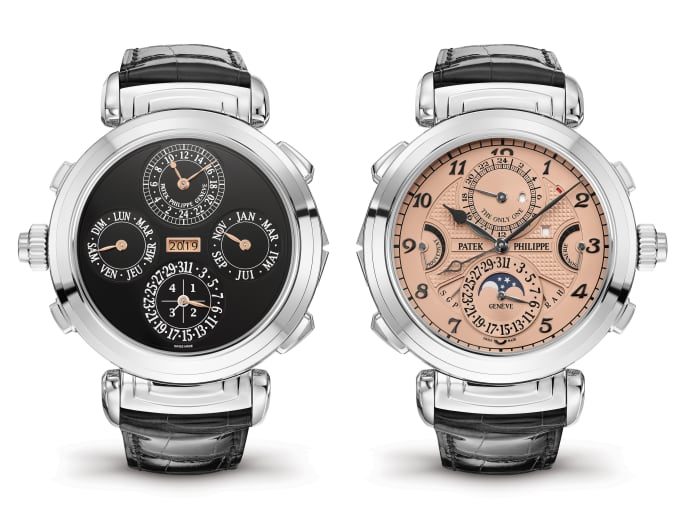
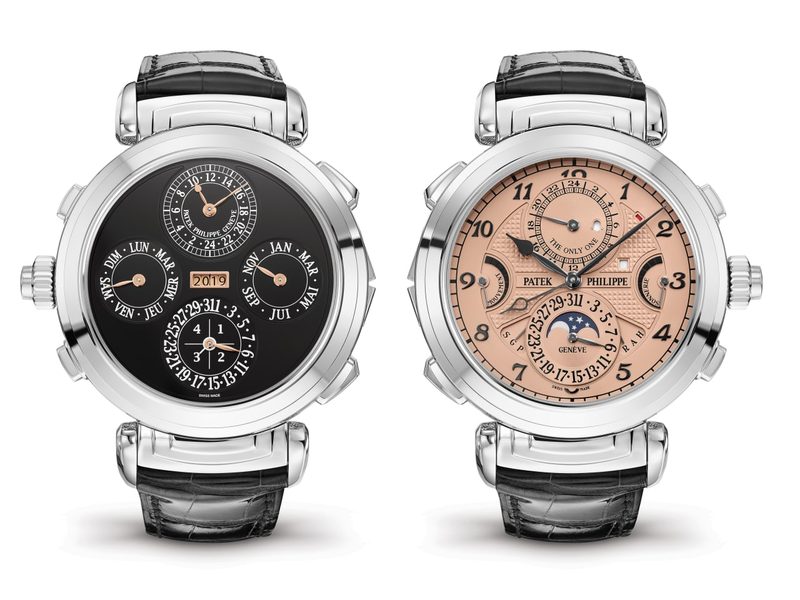
The most expensive wristwatch ever sold remains the Patek Philippe Grandmaster Chime reference 6300A-010, hammered at Christie’s Only Watch charity auction in Geneva on November 9, 2019. The final price — CHF 31,190,000 — shattered the previous record by nearly $14 million. The “A” in 6300A stands for “acier” — steel. This was the only Grandmaster Chime ever produced in stainless steel. Every other 6300 uses white gold.
Twenty complications. A reversible case with two dials. Five chiming modes including grande and petite sonnerie. 1,366 individual parts. Seven new patents. The 6300A was not just the most expensive — it was arguably the most complicated wristwatch ever auctioned. The proceeds went to Duchenne muscular dystrophy research, adding a charitable dimension that likely pushed bidding beyond pure collector valuation. The buyer remains anonymous, as is tradition with Only Watch’s most significant lots.
The Patek Philippe Grandmaster Chime replica allows enthusiasts to experience the visual design of this record-breaking watch — the cushion-shaped reversible case, the double dial layout, and the distinctive pusher configuration that made auction history.
Record Context: The $31.19M sale price equals approximately $857 per individual component. Or, viewed differently, $1.56 million per complication. No other watch has approached this per-complication valuation at auction. The nearest competitor — the Henry Graves Supercomplication — sold for $24.4 million with 24 complications, working out to roughly $1.02 million per complication.
Patek Philippe Henry Graves Supercomplication — $24.4 Million (2014)
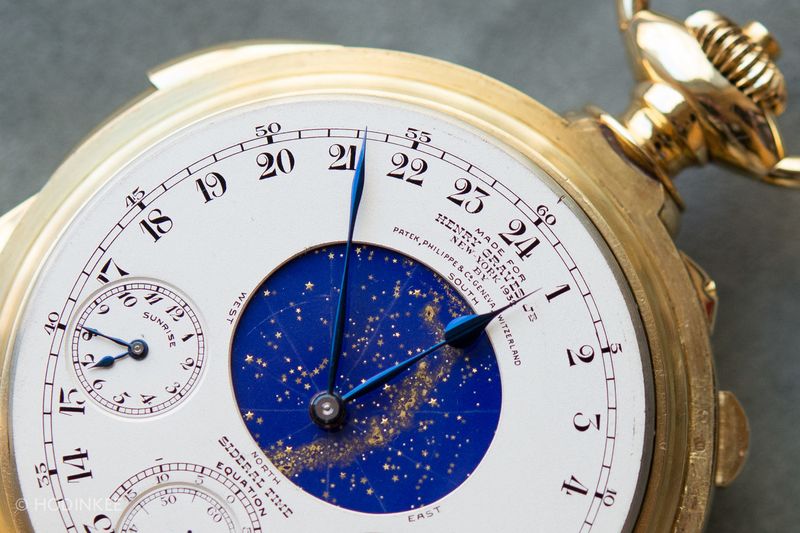
Before the Grandmaster Chime, this pocket watch held the record for a decade. The Henry Graves Supercomplication — a pocket watch, not a wristwatch — sold at Sotheby’s Geneva on November 11, 2014, for CHF 23,237,000 (approximately $24.4 million). Commissioned by New York banker Henry Graves Jr. in 1925 and delivered in 1933, this watch took Patek Philippe eight years to design and build.
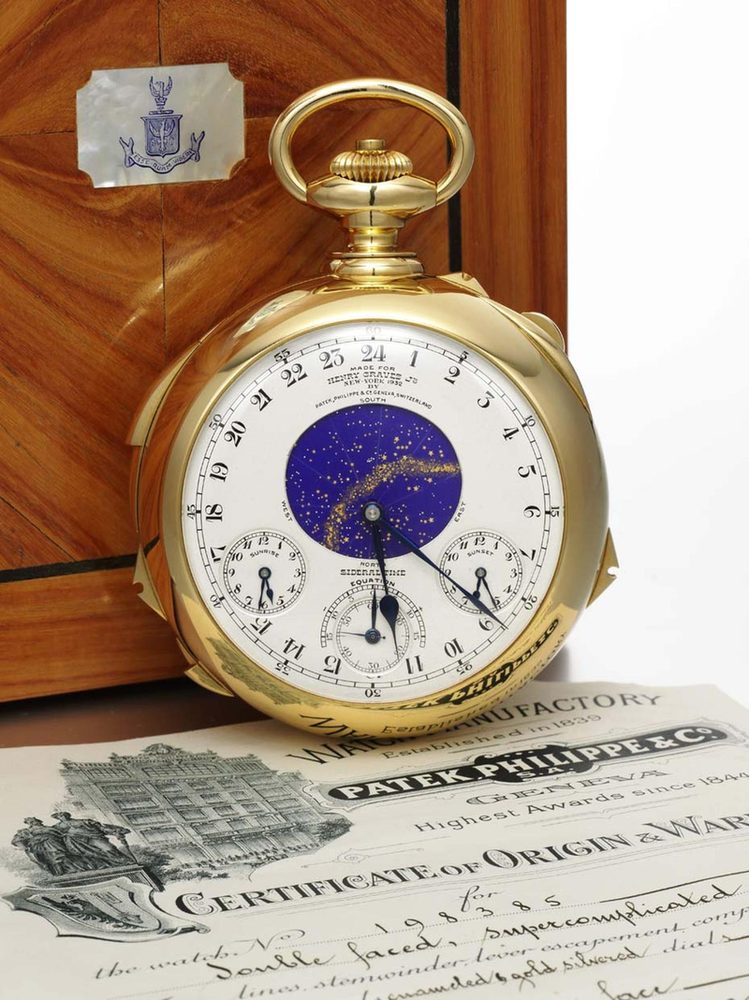
Twenty-four complications packed into a gold case: minute repeater, Westminster chimes, perpetual calendar, sunrise and sunset times for New York City, a celestial chart showing the night sky as seen from Graves’s apartment on Fifth Avenue, grande and petite sonnerie, split-seconds chronograph, and more. The watch was commissioned during a complication war between Graves and automobile manufacturer James Ward Packard, each pushing Patek Philippe to outdo the other’s previous commission. Graves won — the Supercomplication remained the world’s most complicated watch until Patek’s own Calibre 89 surpassed it in 1989.
Rolex Daytona “Paul Newman” Ref. 6239 — $17.75 Million (2017)
The actual Paul Newman’s actual Rolex Daytona. Not a “Paul Newman dial” Daytona that collectors had been chasing for decades — the specific watch that Joanne Woodward gave to Paul Newman in 1968, engraved on the caseback with “DRIVE CAREFULLY ME.” Phillips auctioned it in New York on October 26, 2017, for $17,752,500 — at the time, the most expensive wristwatch ever sold.
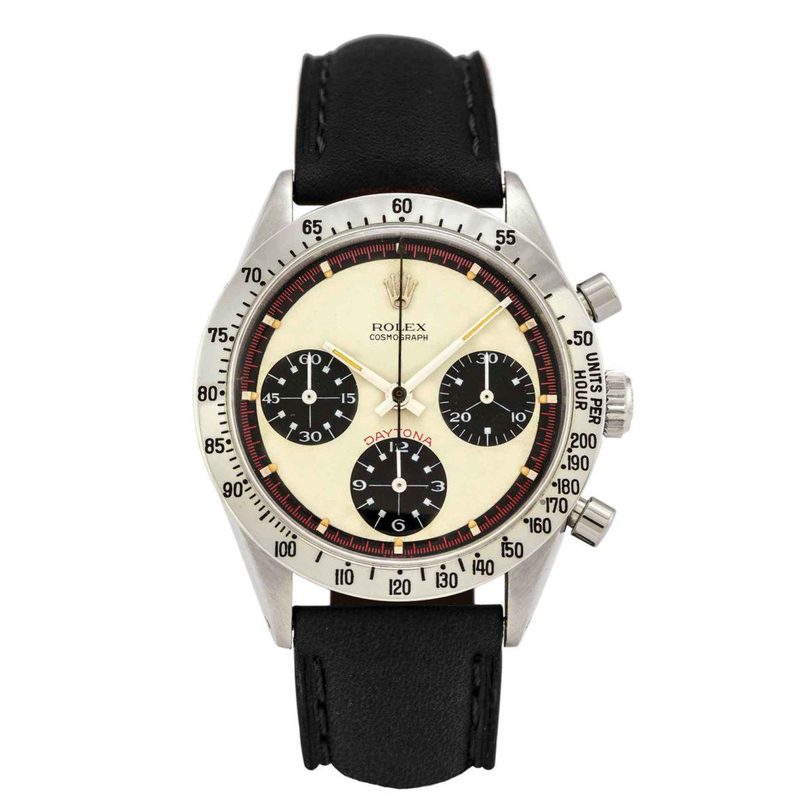
The watch is a Rolex Cosmograph Daytona reference 6239 with the exotic “Paul Newman” dial — a specific dial variation with Art Deco-style font and contrasting sub-dial colors that was originally unpopular. Newman wore this watch daily for fifteen years. Its provenance is bulletproof: Newman gave it to his daughter Nell’s then-boyfriend James Cox, who consigned it to auction decades later. The combination of the world’s most famous watch nickname, the actual celebrity provenance, and the engraved caseback created a perfect storm of collector desire.
Patek Philippe 1518 in Steel — $11.1 Million (2016)
The reference 1518 was the world’s first perpetual calendar chronograph wristwatch produced in series — Patek Philippe made 281 examples between 1941 and 1954. Almost all were gold. Four were made in stainless steel. When one of those four appeared at Phillips Geneva in November 2016, it sold for CHF 11,002,000 (approximately $11.1 million), setting the record for any wristwatch at auction at that time.
Steel Pateks from this era are almost mythical. Gold was the standard luxury material. Steel was considered utilitarian. A steel 1518 likely represents a special order — someone specifically requested the world’s most complicated serially-produced wristwatch in the least prestigious material available. That paradox drives the valuation: the combination of extreme horological significance with extreme material rarity creates a collector object that transcends normal market logic.
Patek Philippe 2499 First Series Pink Gold — $5.69 Million (2024)
The reference 2499 succeeded the 1518 and ran from 1951 to 1985 across four series. First series examples — produced roughly 1951 to 1960 — feature square chronograph pushers and an enamel-printed dial that differs subtly from later versions. Only about 349 examples of the 2499 were made in total across all series, with first series examples numbering fewer than 50.
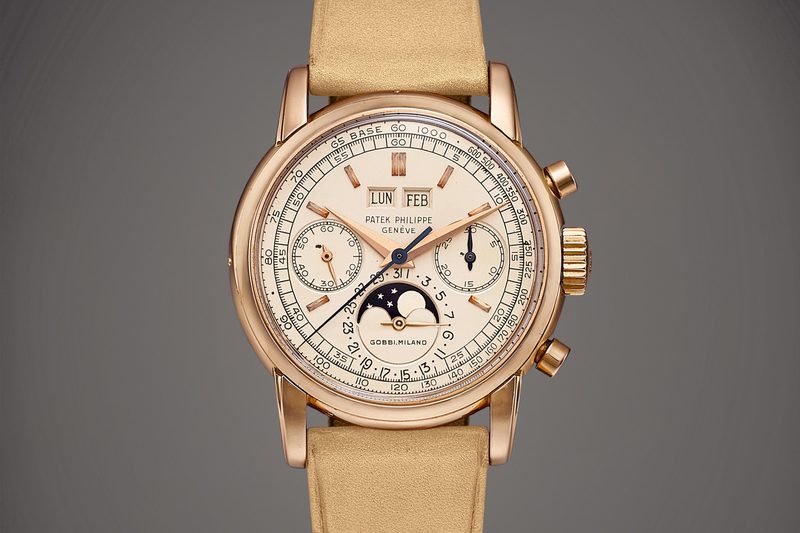
A first series 2499 in pink gold achieved $5.69 million at auction in 2024 — reflecting continued demand for early perpetual calendar chronographs with impeccable provenance. The 2499 carries the Valjoux 23-based movement (later adapted by Patek as the CH 27-70), which preceded the in-house calibers used in modern references. For collectors, the first series represents the transition point between the 1518’s wartime elegance and the 2499’s postwar refinement.
The Complete Top 10 — Updated Through 2026
The full ranking reveals a pattern: Patek Philippe dominates auction records with a consistency no other brand can match. Eight of the top ten most expensive watches ever sold are Patek Philippe. The remaining two — the Paul Newman Daytona and a recent Audemars Piguet — are the exceptions that prove the rule.
What Drives These Prices — The Auction Record Formula
After watching auction records fall for three decades, patterns become visible. It is never just one factor. Record-breaking watches share a specific combination of attributes that, together, create the conditions for extreme bidding.
Rarity of material. The 6300A, the 1518, the 5016A — all stainless steel versions of watches that normally come in precious metals. Steel Patek Philippes from any era are inherently rare because Patek almost never produced in steel before the Nautilus. A steel complication from the mid-20th century might be unique. Uniqueness destroys the concept of “market price” — there is no comparable sale to anchor expectations, so bidders set the price in real time.
Provenance. The Paul Newman Daytona was not just a rare dial variant. It was THE Paul Newman’s watch. The Henry Graves Supercomplication was commissioned by one of America’s wealthiest bankers during the golden age of pocket watch patronage. Stories sell. A watch with a documented, compelling story transcends its mechanical value and enters the world of cultural artifact.
Mechanical significance. The 1518 was the first serially-produced perpetual calendar chronograph wristwatch. The Grandmaster Chime is the most complicated wristwatch ever made. These are not just watches — they are milestones in horological history. Owning one means owning a chapter of that history.
Charity premium. Four of the top ten sold at Only Watch, where proceeds fund medical research. Bidders at charity auctions sometimes push beyond what the market alone would bear — the purchase doubles as a donation, and the public nature of the event encourages competitive generosity among ultra-high-net-worth individuals.
8 / 10
Top 10 watches are Patek Philippe
4 / 10
Are stainless steel (the “wrong” material)
$141M+
Combined value of top 10 lots
2024-2026 Auction Trends — What Changed Recently
The auction market between 2024 and early 2026 showed selective strength. While the broader secondary market for modern luxury watches cooled (Nautilus prices settled, Royal Oak premiums compressed), the ultra-rare vintage segment held firm and occasionally surged. The lesson: mass-produced modern references follow supply-demand cycles. Unique historical pieces follow their own rules.
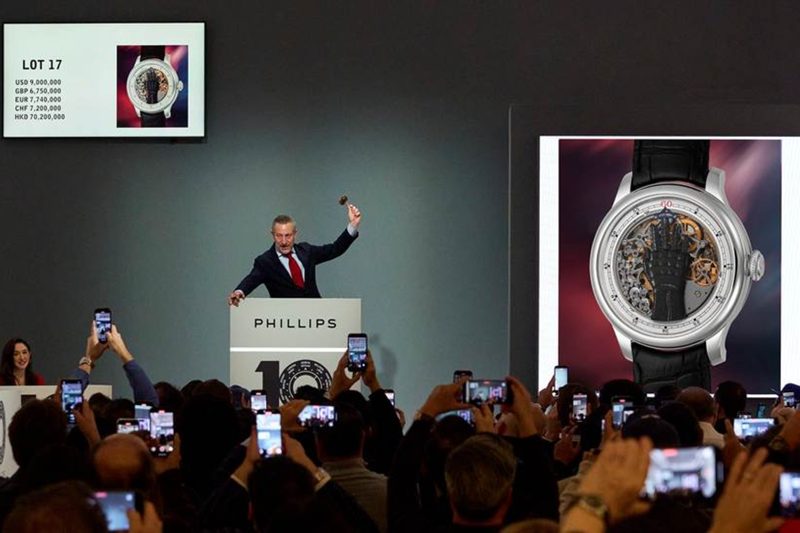
The 2024 auction season saw strong results for Patek Philippe complications across all major houses. Phillips, Christie’s, and Sotheby’s each recorded multiple lots above $3 million for vintage Patek references. The Patek Philippe 1591 steel chronograph — an extraordinarily rare mid-century steel reference — achieved $5.6 million, confirming that the “steel Patek” premium remains solid. A first series 2499 in pink gold reached $5.69 million, setting a new benchmark for that reference.
The Only Watch 2025 auction continued the event’s tradition of record-setting results. A unique Patek Philippe 5016A in steel — combining minute repeater, tourbillon, and perpetual calendar — achieved $5.4 million, entering the all-time top ten. Independent watchmakers also performed strongly at auction during this period, with F.P. Journe and Philippe Dufour pieces regularly exceeding $1 million — a tier that was unthinkable five years ago.
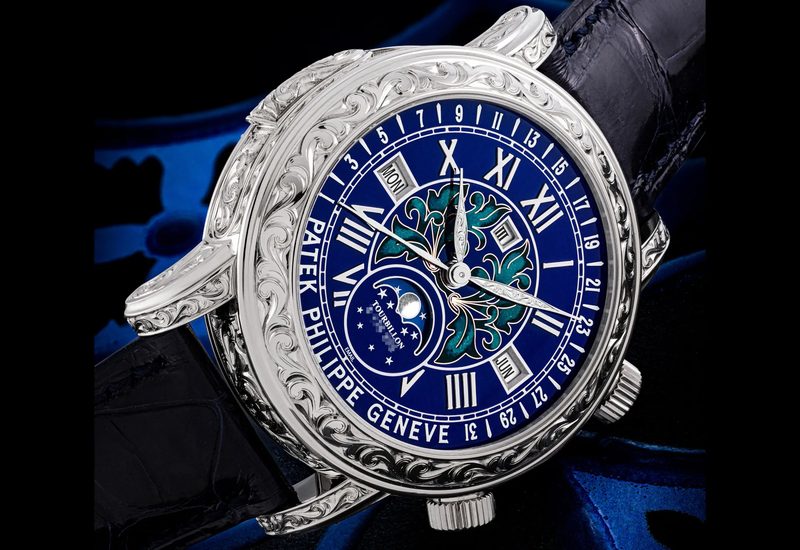
Looking toward the remainder of 2026, several significant consignments are rumored for the fall auction season. The Patek Philippe Sky Moon Tourbillon in steel — if one exists — would instantly challenge the Grandmaster Chime record. An early Nautilus prototype has been discussed in collecting circles. Whether these materialize remains to be seen, but the appetite for exceptional Patek Philippe watches at auction shows no sign of saturation.
Market Observation: The gap between “collectible” and “commodity” in the watch auction market widened between 2024 and 2026. A generic vintage Patek in gold might sell within estimate. A unique variant — unusual dial, rare material, exceptional provenance — regularly doubles or triples its estimate. Collectors are not spending less. They are spending more selectively, concentrating capital on pieces they believe will not come to market again.
Why These Watches Matter Beyond Their Prices
Auction records shape perception. When a Patek Philippe sells for $31 million, it recalibrates what every other Patek is “worth” in the collective imagination. The Grandmaster Chime sale did not just set a record — it established Patek Philippe as the undisputed apex of watch collecting. That gravitational pull affects every reference the company has ever made, from a $25,000 Calatrava to a $500,000 perpetual calendar chronograph.
For enthusiasts who will never bid at these levels, the auction records still matter. They validate the hobby. They attract new collectors to mechanical watchmaking. They generate media coverage that introduces people to complications like minute repeaters and perpetual calendars — complications they might then experience through replicas, entry-level Swiss watches, or museum visits. The $31 million Grandmaster Chime is the tip of a pyramid that supports an entire ecosystem of horological enthusiasm beneath it.
Perspective: The most expensive watch ever sold costs less than a modest Manhattan apartment, less than a decent yacht, and less than many contemporary art pieces. In the universe of ultra-luxury collectibles, watches remain relatively accessible at the top end. That accessibility — relative to art, real estate, or vintage cars — may explain why new billionaire collectors continue entering the watch market. The ceiling has room to rise.
Frequently Asked Questions
Why does Patek Philippe dominate auction records?
Patek Philippe has produced the world’s most complex watches for nearly two centuries. Their limited production numbers (approximately 62,000 watches per year versus Rolex’s estimated 1 million+) creates inherent scarcity. Historical references in unusual materials — especially steel — appear at auction perhaps once per generation. That combination of prestige, complexity, and extreme scarcity drives bidding to record levels.
Why are stainless steel watches more valuable than gold at auction?
The paradox of steel Patek Philippes: steel is a cheaper material than gold, but steel Patek complications are rarer than gold ones because Patek almost never used steel for complications before the modern era. A steel 1518 or 2499 was likely a special order — possibly unique. That extreme rarity inverts the normal material hierarchy. Scarcity trumps intrinsic material value at the collector level.
Could a watch ever sell for more than $31 million?
Almost certainly. The $31 million Grandmaster Chime record will likely fall at a future Only Watch auction or when a truly unique historical piece surfaces. A steel Sky Moon Tourbillon, an unknown Patek grand complication with royal provenance, or a new Patek super-complication created specifically for charity auction could all challenge or exceed the record. The growth trend since 2014 ($24.4M to $31.19M) suggests that $40M+ is achievable within the next decade.
Are modern Patek Philippe watches good investments?
Modern Patek Philippe references in current production rarely approach auction-record territory. The watches that set records are decades old and often unique. Modern references like the Nautilus 5811, Aquanaut 5167, or Annual Calendar 5205 may appreciate over very long holding periods, but treating them as investments is speculative. Buy what you want to wear. If it appreciates, consider that a bonus rather than a strategy.
What role do replicas play in the auction watch ecosystem?
Replicas of iconic auction watches — like the Grandmaster Chime replica or the Sky Moon Tourbillon replica — allow enthusiasts to experience the design language of watches that exist in single-digit quantities. They serve as an entry point to understanding and appreciating complications that most people will never see in person, let alone own.
The most expensive watches ever sold at auction tell a story that transcends horology. They speak to human desire for permanence in a disposable world, for craftsmanship in an age of automation, for objects that carry meaning beyond their function. $31 million for a watch that tells the same time as a phone. But it does not tell time the same way. It tells time through 1,366 hand-finished components assembled over years of human labor. That distinction — between function and meaning — is what the auction hammer measures when it falls. And based on three decades of watching it fall, I expect the next record will make $31 million look like the opening bid.